Ortijes bb, Mostar
info@solaris.ba


Huawei offers leading Smart PV solutions harnessing more than 30 years of expertise in digital information technology. By integrating AI and Cloud, Huawei further incorporates many latest ICT technologies with PV for optimal power generation, thus making the solar power plant to be Highly Efficient, Safe & Reliable with Smart O&M and Grid Supporting capabilities and builds the foundation for solar to become the main energy source. For solar energy users, Huawei launched advanced solution for C&I and residential customers based on the‘Optimal Electricity Cost and Active Safety’ concept. By improving the utilization of solar power, Huawei has helped to power millions of residents and hundreds of industries globally.
Attention: This version includes the PLC module – necessary to connect to inverters using PLC. The version without PLC can be found here.
he Huawei SmartLogger 3000A with PLC is a datalogging device that can connect up to 200 devices, of which 150 can be inverters. This provides information regarding the connected solar modules and inverters. It can easily be mounted and installed due to its light weight and small size. After mounting, there are multiple ways to connect with the SmartLogger.
The Huawei SmartLogger 3000A offers multiple options to connect. The device can connect through the internet (WAN), a local network (LAN), RS485, MBUS (compatible with PLC, includes the required module), mobile networks (2G/3G/4G) and digital and analog options. There are three LEDs to directly see different statuses. An integrated webportal can be used to set up the system, but this can also be done using an app. The SmartLogger also has a USB2.0 port.
The Huawei SmartLogger 3000A with PLC is, only weighing 2kg, relatively light and small in size. It can be directly attached to a wall, to a DIN rail or freestanding on a stable and flat surface.
Cijena: 2400 KM + pdv

Huawei Smart Logger 3000A
The Huawei SmartLogger 3000A is the evolution of the SmartLogger 1000A. It is an intelligent data logger necessary for the monitoring and management of Huawei high-power inverters. It allows the monitoring and data recording of up to a maximum of 80 inverters.
Allows Wi-Fi communication through APP for starting up the equipment.
Dimensions: 225x160x44mm Weight: 2kg
 DatasheetHuawei Smart Logger 3000A
It has communications with WIFI, RS485, MBUS, 2G/3G/4G connections and is used to connect several inverters in parallel in the same photovoltaic plant and monitor them together. The purpose of the HUAWEI SmartLogger 3000A is to send the information registered by the inverter to the HUAWEI portal in order to monitor the solar plant.
SmartLogger 3000A is a data logger compatible with the HUAWEI KTL range of inverters. You also need a compatible wattmeter to take the readings of the installation.
Cijena: 1100 KM + pdv

Smart
2G, 3G, 4G communication in the areas with stable mobile signal.
Support 3rd-party monitoring system.
Simple
Plug & Play installation.
Support max. 10 devices/inverters.
Reliable
P65 degree of protection.
Support auto reconnection.
Adapted to inverter models:
SUN2000-3/4/5/6/8/10KTL-M0;
SUN2000-12/15/17/20KTL-M0;
SUN2000-60KTL-M0;
SUN2000-100KTL-M1;
Weight: 90 g.
Dimension (w*h*d): 130 x 48 x 33 mm
Cijena: 360 KM + PDV
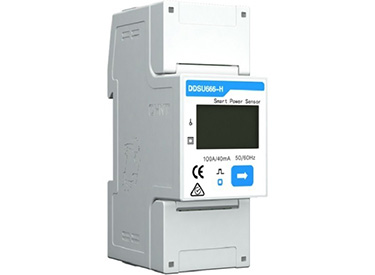
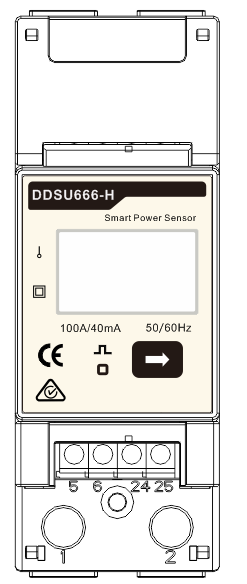
Type DDSU666-H Smart Power Sensor (hereinafter referred to as the " Sensor ") is specially designed for the distributed photovoltaic system, to be a new Smart power sensor, combined with measurement and communication, mainly applied into the measurement for electrical quantity including voltage, current, power ,frequency, power factor, active energy etc. in the electrical circuit. It can realize networking with the external device through RS485 communication interface. Adopting the standard DIN35mm din rail mounting, structural module design, it is characterized with small volume, easy installation and networking, etc.
This performance index of the meter conforms to the following relevant technical standard:
- EN 61326-1:2013
- IEC 61326-1:2012
- EN 61326-2-1:2013
- IEC 61326-2-1:2012
- EN 61010-1:2010
- IEC 61010-1:2010
- EN 61010-2-1:2010
- IEC 61010-2-1:2010
Figure 2-1 DDSU666-H